A physician in a white coat using a model of a kidney to show where kidney stones can appear

Kidney Stones Suck

From small stones to large, soft to hard, they vary as widely as the millions of people who suffer from them. Learn about different types of kidney stones, how they form, treatment options, and more.

Meet the One-Of-A-Kind CVAC System

Most kidney stone treatments leave stone fragments behind in the body.1 These leftover pieces are linked to more unplanned post-procedure health events, such as ER visits, hospital stays, and additional procedures.*,2


That’s why the unique, vacuum-based CVAC System is designed to help your physician completely remove kidney stones during the procedure itself.
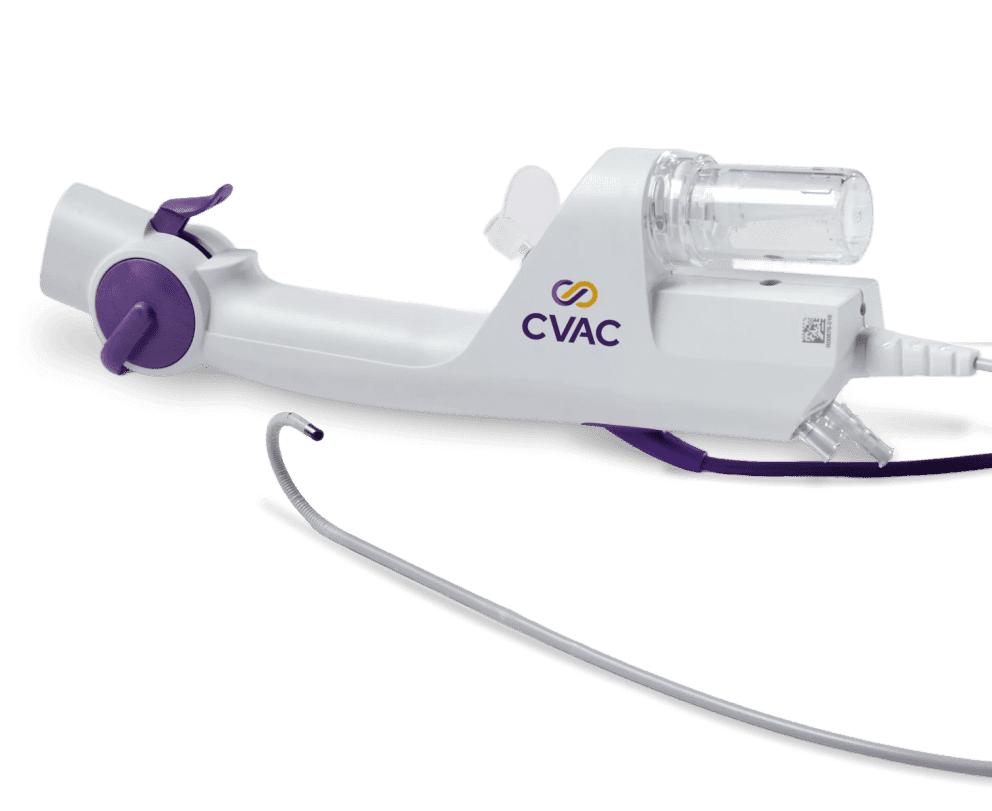
A picture of the handpiece for the CVAC System kidney stone treatment

Why Choose the CVAC System?

A surgeon in scrubs holding a container of kidney stones collected with the CVAC System

Removes Kidney Stones During Treatment

The CVAC System vacuums out kidney stones in real time, offering you more complete treatment than procedures that leave stone fragments behind.1,2
A patient anxiously waiting for his kidney stones to pass

Helps You Avoid Passing Stones on Your Own

Leftover fragments can take days or weeks to pass, and may cause other problems.1,2 The CVAC System can help you focus on healing instead of waiting for stones to pass.

A patient consulting a physician about kidney stone treatment options

Fewer Unplanned Health Events Unplanned health events are ER visits, hospital stays, or additional procedures likely due to stones left behind after your initial procedure. in the Future2

Patients treated with the CVAC System saw 73% fewer unplanned post-procedure health events, such as ER visits, hospital stays, and additional procedures* — giving you greater peace of mind.

The CVAC System in Action

The minimally invasive CVAC System procedure is clinically proven to clear more kidney stones.3-6 See how it works and what to expect, from prep to recovery.
A physician’s gloved hand holding the handpiece of the CVAC System kidney stone treatment

Ready to Leave Your Kidney Stones in the Dust?

Use our locator to find a CVAC System physician near you — and be sure to ask for the CVAC System procedure!

* Limited to additional procedures likely due to stones left behind after your initial procedure
† After 2 years, compared to standard ureteroscopy
MAC00270.A
  1. Mayo Clinic. Kidney Stones. MayoClinic.org. Medically reviewed April 4, 2025. Accessed December 2, 2025. https://www.mayoclinic.org/diseases-conditions/kidney-stones/diagnosis-treatment/drc-20355759.
  2. Stern, et al. MP16: 01 Steerable ureteroscopic renal evacuation reduces the risk of healthcare consumption events at 2 years compared to standard ureteroscopy (URS). Conference Presentation, WCET 2025.
  3. Cabo et. al. MP29-04: Prospective Comparison of Flexible and Navigable Ureteric Access Sheath (FANS) and CVAC 2.0 In-Scope Aspiration System for High-Volume Stone Disease, Conference Presentation, AUA 2025.
  4. Klyde et. al. PD01-06: Real-World Experience with CVAC 2.0 for Steerable Ureteroscopic Renal Evacuation in a Large, Multi-Site Academic Institution, Conference Presentation, AUA 2025.
  5. Cook et. al. IP08-19: A Retrospective Analysis of the 2nd Generation CVAC Ureteroscope’s Stone Clearance: Our Initial Experience, Conference Presentation, AUA 2025.
  6. Griffiths et. al. IP11-10: Early Experience of Steerable Ureteroscopic Evacuation (S.U.R.E) with CVAC System Next Gen 2.0 — with Quantitative Computer Tomography, Conference Presentation, AUA 2025.
Individual results may vary. Speak with your doctor to determine what treatment may be right for you. There are risks of complications with the CVAC System procedure including, but not limited to: perforation, bleeding, damage to ureter or kidney, pain, inflammation, infection, and/or fever. In some cases, complications may require intervention and may lead to a serious outcome. View full safety information here.
MAC00270.A

Contact Us for More Information About the CVAC System Procedure

This field is for validation purposes and should be left unchanged.
Checkboxes(Required)

MA00171-01.A